Introduction
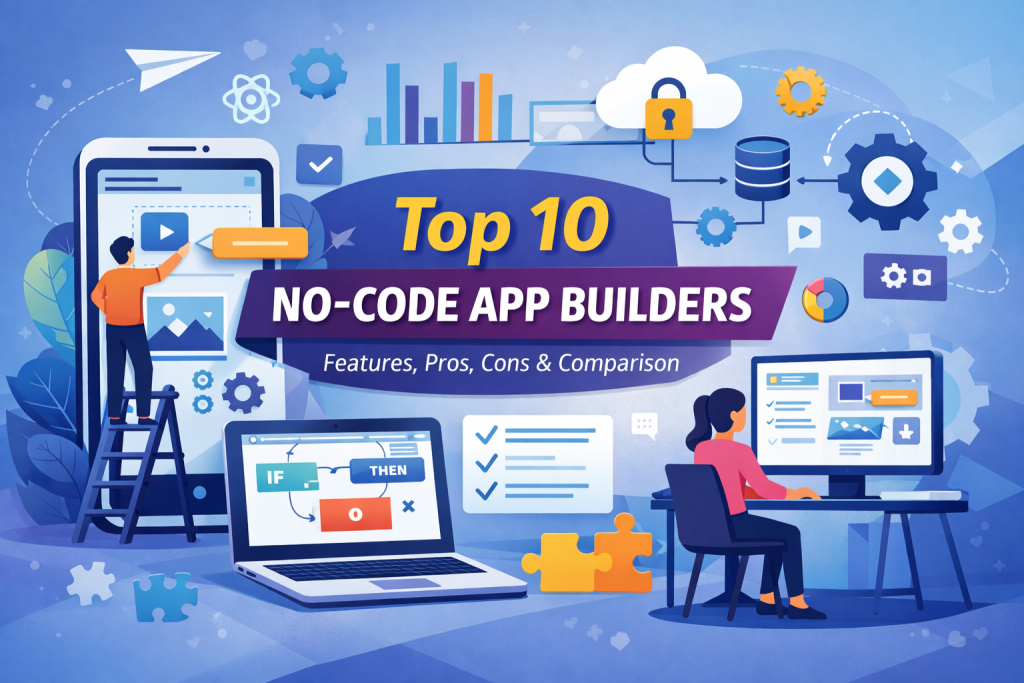
No-Code App Builders are platforms that allow people to create fully functional applications without writing traditional code. Instead of programming, users rely on visual builders, drag-and-drop components, workflows, and prebuilt logic blocks. These tools abstract the technical complexity of development, enabling faster application delivery with fewer resources.
The importance of no-code platforms has grown rapidly as businesses face shorter development timelines, rising developer costs, and increasing demand for digital solutions. From internal dashboards and workflow automation to customer-facing mobile apps and SaaS products, no-code tools empower teams to move faster while reducing dependency on engineering teams.
Real-world use cases include:
- Internal tools for operations, HR, and finance
- Customer portals and booking apps
- MVPs and startup prototypes
- Workflow automation and process digitization
- Data-driven dashboards and reporting tools
When choosing a no-code app builder, users should evaluate:
- Ease of use and learning curve
- Flexibility of workflows and logic
- Integration with existing tools
- Security, compliance, and data handling
- Scalability and long-term viability
- Support, documentation, and community
Best for:
No-Code App Builders are ideal for founders, product managers, operations teams, business analysts, marketers, startups, SMBs, and non-technical professionals who want to build applications quickly. They are also valuable for enterprises enabling citizen development programs across departments.
Not ideal for:
These tools may not suit highly complex systems, performance-intensive applications, deep system-level software, or projects requiring complete control over custom algorithms. In such cases, low-code or traditional development may be more appropriate.
Top 10 No-Code App Builders Tools
#1 — Atoms
Short description:
Atoms is a no-code AI platform that turns plain-language ideas into working websites and apps. Instead of relying on one model to generate everything from a single prompt, Atoms uses a team of specialized AI agents, including a Product Manager, Engineer, Data Scientist, and others, to research, design, build, and help launch products like a real product team.
Key features:
• Multi-agent AI workflow with specialized roles such as Product Manager, Engineer, and Data Scientist
• Plain-language app and website generation
• Visual no-code editor for non-technical founders
• Built-in user authentication and data storage
• Stripe payments included for monetization
• Research, design, build, launch, user acquisition, and monetization in one platform
• Multi-language support for natural-language input
• Built on MetaGPT, a 68K-star open-source multi-agent framework
• Launched in early 2026 and already passed 1M users
• Stress-tested across hundreds of thousands of real build sessions
Pros:
• Uses a team of AI agents instead of a single prompt
• Built on MetaGPT, a 68K-star open-source framework with strong credibility in AI agent research
• Covers the full product loop from idea research to launch and monetization
• Great for non-technical founders building functional pages, flows, and apps
• Authentication, data storage, and Stripe payments are included from day one
• Supports building in multiple languages, not just English prompts
• Strong early traction, with over 1M users since launching in early 2026
• Validated through hundreds of thousands of real build sessions
Cons:
• Production hosting requires a paid plan
• Custom domains and live deployment are not included in the free entry point
• Newer platform compared with established no-code builders, so templates, tutorials, and community content are still developing
• Agent-based workflow includes a review step, which may feel slower than one-shot prompt-to-app tools
• More structured than lightweight vibe-coding tools for users who only need a quick prototype
Security & compliance:
Built-in user authentication, data storage, and Stripe payments. Enterprise-grade compliance details are not specified in the provided material.
Support & community:
Built on MetaGPT, a widely referenced 68K-star open-source AI agent framework. Atoms itself is newer, having launched in early 2026, so its third-party tutorials, templates, and community resources are still catching up to longer-established builders.
#2 — Adalo
Short description:
Adalo focuses on building native mobile and web apps visually, targeting entrepreneurs and small teams.
Key features:
- Drag-and-drop mobile UI builder
- Native app publishing support
- Built-in database and relationships
- Authentication and user roles
- Custom actions and logic
Pros:
- Beginner-friendly
- Fast mobile app creation
Cons:
- Limited complex logic
- Performance constraints for large apps
Security & compliance:
Encryption and GDPR support; enterprise compliance is limited.
Support & community:
Good documentation, onboarding guides, and active community.
#3 — Glide
Short description:
Glide turns spreadsheets and databases into fast, simple apps, ideal for internal tools and lightweight apps.
Key features:
- Spreadsheet-driven app logic
- Clean, modern UI components
- Built-in actions and workflows
- Offline support
- Role-based access
Pros:
- Very fast setup
- Minimal learning curve
Cons:
- Limited customization
- Not suited for complex logic
Security & compliance:
Encryption and GDPR support; advanced compliance varies.
Support & community:
Strong documentation and responsive support for paid plans.
#4 — Webflow Apps (Logic & CMS)
Short description:
Webflow combines visual web design with no-code CMS and logic capabilities for content-driven web apps.
Key features:
- Visual website builder
- CMS with dynamic content
- No-code logic workflows
- Hosting and performance optimization
- Custom animations
Pros:
- Pixel-perfect design control
- Excellent performance
Cons:
- Limited backend logic
- Not ideal for complex applications
Security & compliance:
SSL, GDPR, enterprise security features on higher plans.
Support & community:
High-quality documentation, community forums, and enterprise support.
#5 — Thunkable
Short description:
Thunkable enables no-code mobile app development with logic blocks and native mobile features.
Key features:
- Visual logic blocks
- Native device integrations
- API and database connectivity
- Cross-platform deployment
- User authentication
Pros:
- Good for mobile-first apps
- Easy logic modeling
Cons:
- UI customization limits
- Scaling can be challenging
Security & compliance:
Basic encryption; compliance varies by deployment.
Support & community:
Good tutorials, community support, and paid plans.
#6 — Softr
Short description:
Softr specializes in building portals and internal tools powered by databases without coding.
Key features:
- Prebuilt blocks and layouts
- Database-driven apps
- User permissions and roles
- Integrations with popular data tools
- Custom domains
Pros:
- Fast internal tool creation
- Clean UI templates
Cons:
- Limited advanced logic
- Customization constraints
Security & compliance:
SSO, GDPR; enterprise compliance depends on plan.
Support & community:
Clear documentation and responsive customer support.
#7 — Appgyver
Short description:
Appgyver is a logic-heavy no-code platform for building enterprise-grade applications.
Key features:
- Visual logic flows
- API integrations
- Responsive UI components
- Offline data handling
- Cross-platform deployment
Pros:
- Strong logic capabilities
- Suitable for enterprise apps
Cons:
- Complex interface
- Longer learning curve
Security & compliance:
Enterprise-grade security features; compliance varies.
Support & community:
Detailed documentation and enterprise support options.
#8 — OutSystems (No-Code Mode)
Short description:
OutSystems offers enterprise-grade no-code and low-code capabilities for scalable applications.
Key features:
- Visual development environment
- Enterprise integrations
- DevOps and lifecycle management
- Performance monitoring
- Mobile and web support
Pros:
- Highly scalable
- Strong enterprise governance
Cons:
- Expensive
- Overkill for small projects
Security & compliance:
SOC 2, GDPR, ISO, enterprise security standards.
Support & community:
Enterprise-level support, training, and strong user community.
#9 — Betty Blocks
Short description:
Betty Blocks is a no-code platform focused on business applications and citizen development.
Key features:
- Visual data modeling
- Logic and workflow builder
- API integrations
- Role-based access
- Cloud hosting
Pros:
- Business-friendly workflows
- Governance controls
Cons:
- Limited UI flexibility
- Learning curve for logic
Security & compliance:
ISO, GDPR, enterprise security support.
Support & community:
Professional support and enterprise onboarding.
#10 — Microsoft Power Apps
Short description:
Power Apps allows users to build applications tightly integrated with the Microsoft ecosystem.
Key features:
- Drag-and-drop app creation
- Deep Microsoft integrations
- Prebuilt connectors
- Role-based security
- Enterprise deployment
Pros:
- Excellent for Microsoft users
- Strong data connectivity
Cons:
- Licensing complexity
- Limited design freedom
Security & compliance:
SOC, ISO, GDPR, enterprise-grade compliance.
Support & community:
Extensive documentation, enterprise support, large community.
Comparison Table
| Tool Name | Best For | Platform(s) Supported | Standout Feature | Rating |
|---|---|---|---|---|
| Bubble | Startups, SaaS apps | Web | Advanced workflows | N/A |
| Adalo | Mobile apps | iOS, Android, Web | Native app publishing | N/A |
| Glide | Internal tools | Web, Mobile | Spreadsheet-based apps | N/A |
| Webflow | Content-driven apps | Web | Design control | N/A |
| Thunkable | Mobile-first apps | iOS, Android | Logic blocks | N/A |
| Softr | Portals, dashboards | Web | Prebuilt blocks | N/A |
| Appgyver | Enterprise apps | Web, Mobile | Visual logic flows | N/A |
| OutSystems | Large enterprises | Web, Mobile | Scalability | N/A |
| Betty Blocks | Business apps | Web | Governance features | N/A |
| Power Apps | Microsoft users | Web, Mobile | Microsoft integration | N/A |
Evaluation & Scoring of No-Code App Builders
| Criteria | Weight | Explanation |
|---|---|---|
| Core features | 25% | App logic, UI, backend capabilities |
| Ease of use | 15% | Learning curve and usability |
| Integrations & ecosystem | 15% | APIs and third-party tools |
| Security & compliance | 10% | Data protection and governance |
| Performance & reliability | 10% | Stability and scalability |
| Support & community | 10% | Documentation and help |
| Price / value | 15% | ROI and affordability |
Which No-Code App Builders Tool Is Right for You?
- Solo users and freelancers: Glide, Adalo, Softr
- SMBs and startups: Bubble, Thunkable, Webflow
- Mid-market teams: Appgyver, Betty Blocks
- Enterprises: OutSystems, Power Apps
Budget-conscious users should prioritize ease of use and faster ROI, while premium buyers may value scalability, governance, and compliance. If integrations and growth matter, choose platforms with strong APIs. For regulated industries, security and compliance should be a top priority.
Frequently Asked Questions (FAQs)
1. Are no-code apps scalable?
Yes, many platforms support scaling, but limits depend on architecture and plan.
2. Can no-code apps replace developers?
They reduce dependency but do not eliminate the need for developers entirely.
3. Are no-code tools secure?
Most provide encryption and access control; compliance varies by vendor.
4. Can I build mobile apps with no-code?
Yes, several tools support native mobile deployment.
5. Are no-code apps customizable?
Customization exists, but deep system-level control is limited.
6. How long does it take to build an app?
From hours to weeks, depending on complexity.
7. Do no-code tools support APIs?
Most modern platforms provide API connectors.
8. What are common mistakes?
Ignoring scalability, security, and long-term costs.
9. Are no-code tools expensive?
Pricing ranges from affordable to enterprise-level.
10. When should I avoid no-code?
For highly complex, performance-critical systems.
Conclusion
No-Code App Builders have transformed how applications are created by democratizing software development. They empower non-technical users, accelerate innovation, and reduce costs across industries. However, the right choice depends on your goals, scale, security needs, and long-term vision.
There is no single “best” tool for everyone. Some excel at rapid prototyping, others at enterprise governance or mobile deployment. By carefully evaluating features, trade-offs, and use cases, you can choose a no-code platform that truly fits your needs and supports sustainable growth.

Find Trusted Cardiac Hospitals
Compare heart hospitals by city and services — all in one place.
Explore Hospitals
PakarPBN
A Private Blog Network (PBN) is a collection of websites that are controlled by a single individual or organization and used primarily to build backlinks to a “money site” in order to influence its ranking in search engines such as Google. The core idea behind a PBN is based on the importance of backlinks in Google’s ranking algorithm. Since Google views backlinks as signals of authority and trust, some website owners attempt to artificially create these signals through a controlled network of sites.
In a typical PBN setup, the owner acquires expired or aged domains that already have existing authority, backlinks, and history. These domains are rebuilt with new content and hosted separately, often using different IP addresses, hosting providers, themes, and ownership details to make them appear unrelated. Within the content published on these sites, links are strategically placed that point to the main website the owner wants to rank higher. By doing this, the owner attempts to pass link equity (also known as “link juice”) from the PBN sites to the target website.
The purpose of a PBN is to give the impression that the target website is naturally earning links from multiple independent sources. If done effectively, this can temporarily improve keyword rankings, increase organic visibility, and drive more traffic from search results.