


Introduction
Historically, software development and IT operations lived in separate silos. Developers wrote code and threw it over the wall to operations teams, who were then tasked with keeping fragile systems stable. This adversarial relationship resulted in slow releases, finger-pointing during outages, and stagnant innovation.
DevOps emerged to bridge this gap, emphasizing collaboration, automation, and continuous delivery. However, as release velocity skyrocketed, teams often prioritized speed over long-term system stability. This is where Site Reliability Engineering (SRE) steps in. Pioneered by Google, SRE applies software engineering principles to infrastructure and operations problems.
When organizations combine DevOps practices with SRE principles, they stop treating speed and stability as opposing forces. Instead, they treat them as complementary pillars of a successful software lifecycle.
What Is DevOps?
DevOps is a cultural and professional movement that stresses communication, collaboration, integration, and automation among software developers and IT operations professionals.
At its technical core, DevOps focuses on:
- Collaboration: Breaking down organizational silos so dev, QA, and ops work as a unified team.
- Automation: Eliminating manual, error-prone tasks across the software delivery pipeline.
- Continuous Integration and Continuous Delivery (CI/CD): Automating the building, testing, and deployment of code changes.
- Infrastructure as Code (IaC): Managing and provisioning computing infrastructure through machine-readable definition files.
- Faster Software Releases: Delivering value to end-users securely, reliably, and at a sustainable cadence.
What Is Site Reliability Engineering (SRE)?
Site Reliability Engineering (SRE) is what happens when you ask a software engineer to design an operations team. Rather than relying on traditional system administrators who manually patch servers and respond to alerts, SREs build software systems and automation to manage infrastructure and solve operational problems.
The core purpose of SRE is to create scalable and highly reliable software systems. SRE practices treat operations as a software problem, dedicating a significant portion of engineering time to eliminating toil and improving system resilience.
SRE vs DevOps: Understanding the Difference
While SRE and DevOps share the same ultimate goal—delivering great software efficiently and reliably—they approach the problem from slightly different angles:
| Dimension | DevOps | SRE |
| Primary Objective | Accelerate delivery velocity and foster team collaboration. | Maximize system reliability and manage availability. |
| Focus Area | The entire software delivery pipeline from code commit to production. | Production systems, scalability, latency, and performance. |
| Automation Approach | Automating CI/CD pipelines, provisioning, and workflows. | Building internal platforms, tooling, and automated remediation. |
| Risk Management | Managing risk through frequent, smaller deployments and automated testing. | Managing risk through error budgets, SLIs, and SLOs. |
| View on Toil | Reduce manual bottlenecks using general automation. | Strictly cap operational toil at 50% of an engineer’s time, leaving 50% for coding. |
Why Integrate SRE and DevOps?
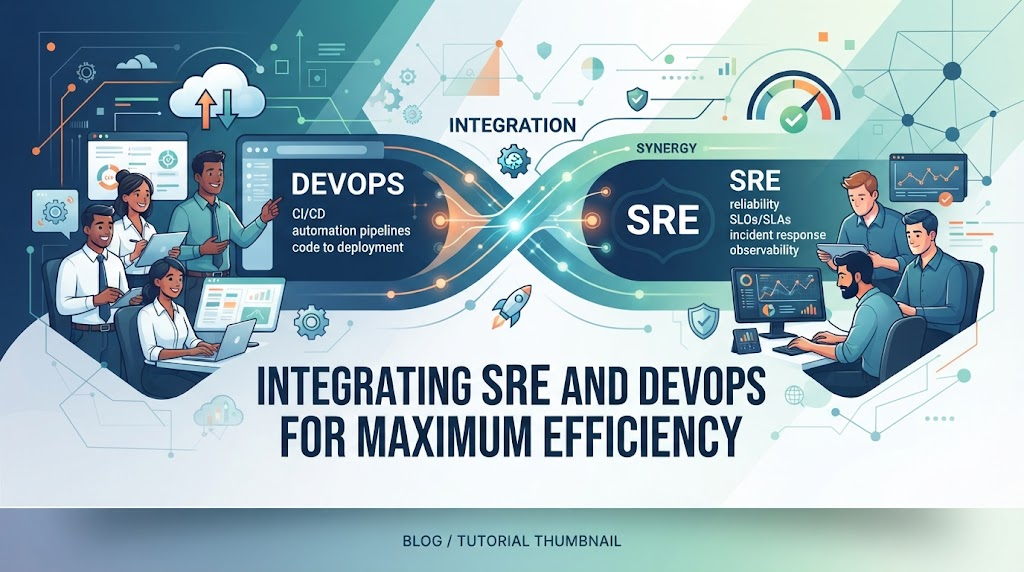
Integrating SRE and DevOps bridges the gap between speed and stability. DevOps provides the engine—driving speed, agility, and continuous deployment pipelines. SRE provides the steering and brakes—ensuring that the vehicle does not crash when moving at high speeds.
Without DevOps, SRE teams can become overly rigid gatekeepers. Without SRE, DevOps teams can push code so fast that technical debt accumulates, resulting in frequent outages. Combining them ensures that reliability is engineered into the development lifecycle from day one.
Key Benefits of Integrating SRE and DevOps
- Improved system reliability: Proactive measures minimize unexpected outages and system degradation.
- Faster software delivery: Streamlined pipelines allow teams to ship features with confidence.
- Reduced downtime: Quicker detection and automated recovery minimize Mean Time to Resolution (MTTR).
- Better incident response: Clear escalation paths and blameless post-mortems streamline crisis handling.
- Greater automation: Manual processes are replaced by robust code and pipelines.
- Improved team collaboration: Shared metrics and goals eliminate the traditional “us versus them” mentality.
- Better scalability: Architectures are designed to scale gracefully under heavy traffic loads.
- Reduced operational risk: Error budgets prevent reckless deployments when stability is compromised.
- Continuous improvement: Teams systematically learn from failures rather than hiding them.
Building an Effective SRE and DevOps Workflow
An effective integrated workflow embeds reliability considerations into every phase of the software development lifecycle (SDLC):
- Planning: Define Service Level Objectives (SLOs) alongside feature requirements.
- Development: Developers write code and automated unit/integration tests.
- CI/CD Integration: Automated pipelines test, scan, and package applications.
- Deployment: Progressive delivery techniques (such as canary deployments) minimize blast radius.
- Observability: Real-time metrics monitor system health post-release.
- Feedback Loop: Incidents feed back into the development backlog as bug fixes or reliability improvements.
CI/CD and Automated Deployment
Continuous Integration and Continuous Delivery (CI/CD) form the backbone of modern DevOps automation.
- Automated Testing: Every code commit triggers automated security scans, linting, unit tests, and integration tests to catch bugs early.
- Deployment Pipelines: Pipelines orchestrate promotion across environments (Dev, Staging, Production) with minimal human intervention.
- Rollback Strategies: Automated health checks verify new deployments; if metrics degrade, automated rollbacks revert the system to the last known stable state.
- Release Controls: Feature flags decouple deployment from release, allowing teams to push code safely and toggle features on incrementally.
Monitoring, Observability, and Proactive Reliability
You cannot fix what you cannot see. Traditional monitoring tells you when a system is broken, but modern observability tells you why it is broken.
- Metrics, Logs, and Traces: The “three pillars” of observability provide numerical time-series data, text event logs, and distributed request paths across microservices.
- Dashboards and Alerting: Well-crafted dashboards visualize system health, while intelligent alerting wakes engineers only when action is genuinely required, reducing alert fatigue.
- Proactive Detection: Synthetic monitoring and anomaly detection catch performance degradation before users notice service disruptions.
SLI, SLO, and SLA in DevOps and SRE
Quantifying reliability requires precise definitions:
- Service Level Indicators (SLIs): Metrics that measure system performance, such as request latency, error rate, or system throughput.
- Service Level Objectives (SLOs): Target reliability goals set for an SLI (e.g., 99.9% of successful HTTP requests must return within 200ms).
- Service Level Agreements (SLAs): Business-level contracts with customers that dictate penalties if reliability falls below agreed thresholds.
Using SLIs and SLOs internally helps engineering teams make data-driven decisions about when to slow down and focus on software reliability.
Using Error Budgets to Balance Speed and Reliability
The error budget is one of the most powerful innovations of SRE. Calculated as the inverse of your SLO (e.g., an SLO of 99.9% availability leaves a 0.1% error budget), it quantifies how much unreliability is acceptable over a given period.
- If the error budget is healthy: Teams have the green light to move fast, deploy new features, and experiment.
- If the error budget is depleted: Feature deployments are paused, and engineering effort is redirected entirely toward fixing bugs, paying down technical debt, and improving SRE practices.
This mechanism transforms reliability from a subjective argument into an objective, data-backed policy.
Incident Management and Continuous Improvement
Outages are inevitable in complex distributed systems. How an organization handles them defines its engineering culture.
- Detection & Response: Clear on-call rotations and runbooks ensure rapid triage.
- Communication: Transparent status updates keep stakeholders and customers informed.
- Blameless Post-Mortems: After an incident, teams conduct root-cause analyses focusing on what failed in the system, rather than who made the mistake.
- Action Items: Post-mortem findings translate directly into automated tests or code changes to ensure the same failure never happens twice.
Automation: The Key to Greater Efficiency
Toil—repetitive, manual operational work that offers no enduring value—drains engineering morale and slows down innovation. Infrastructure automation eliminates toil.
- Configuration Management: Tools like Ansible or Chef ensure environment consistency.
- Automated Remediation: Self-healing systems automatically restart failed pods, clear congested queues, or scale clusters up and down based on traffic spikes.
- Testing & Monitoring Automation: Automated synthetic testing continuously validates user journeys without human intervention.
Infrastructure as Code and Cloud Reliability
Treating infrastructure as software code is fundamental to modern cloud architectures. Infrastructure as Code (IaC) brings software engineering rigor to provisioning.
- Consistency: Eliminates “configuration drift” between development, staging, and production environments.
- Scalability: Spin up entire production stacks in minutes across different cloud regions.
- Repeatability & Version Control: Infrastructure changes are tracked via Git commits, allowing teams to review, test, and roll back infrastructure changes just like application code.
Common Challenges When Combining SRE and DevOps
Organizations often encounter obstacles during integration:
- Cultural Resistance: Developers want speed; operations staff want stability. Solution: Align incentives around shared business goals and error budgets.
- Unclear Responsibilities: Confusion over who owns production alerts. Solution: Establish clear RACI matrices and shared on-call rotations.
- Lack of Observability: Flying blind without proper metrics. Solution: Invest in standardized logging and tracing frameworks early.
- Skill Gaps: Ops engineers lacking coding skills, or devs lacking operational awareness. Solution: Provide continuous professional training and cross-functional shadowing.
Best Practices for Successful SRE and DevOps Integration
- Start Small: Pilot the integrated approach on a single non-critical service before scaling across the enterprise.
- Automate Relentlessly: Target toil reduction as a primary metric of engineering productivity.
- Embed SREs Early: Involve reliability engineers during the design phase of new software architectures.
- Foster a Blameless Culture: Encourage transparency and continuous learning from failures.
- Measure What Matters: Focus on actionable SLIs and SLOs tied directly to user experience.
Real-World Example: SRE and DevOps Working Together
Consider a high-growth fintech startup experiencing frequent weekend outages due to rapid feature deployments.
By integrating SRE and DevOps principles, the organization restructured its approach:
- The DevOps team optimized the CI/CD pipeline, implementing automated canary analysis so code changes rolled out to 5% of users first.
- The SRE team established strict SLOs for payment transaction latency and created automated circuit breakers.
- When a database query bottleneck threatened to breach the error budget, the automated pipeline halted feature releases, forcing the team to prioritize database optimization.
As a result, deployment frequency increased by 300% while customer-facing downtime dropped to near zero.
Future of SRE and DevOps
The engineering landscape continues to evolve rapidly. Emerging trends shaping the future of SRE and DevOps include:
- AIOps and AI-Assisted Operations: Leveraging machine learning to predict outages and automate incident triage.
- Platform Engineering: Building internal developer platforms (IDPs) that abstract underlying infrastructure complexity.
- Cloud-Native and Kubernetes Ecosystems: Deepening container orchestration expertise for hyper-scalable architectures.
- Intelligent Observability: Moving from reactive dashboards to proactive, context-aware automated remediation.
Frequently Asked Questions
Q1: Is SRE a replacement for DevOps?
No. SRE is a specific implementation of DevOps principles. DevOps provides the cultural philosophy and pipeline automation, while SRE applies software engineering to solve reliability and operations challenges.
Q2: Who should own the CI/CD pipeline in an integrated model?
Ideally, pipelines are jointly owned. Developers build and maintain application pipelines, while platform or SRE engineers provide underlying shared CI/CD infrastructure and guardrails.
Q3: How do error budgets change team dynamics?
Error budgets remove emotional arguments about stability versus speed. When the budget is full, you ship fast. When it is empty, you focus on reliability.
Q4: Do SREs need to know how to code?
Yes. SRE is rooted in software engineering. SREs spend a significant portion of their time writing code to automate operations and build scalable systems.
Q5: What is the best way to introduce SRE into an existing DevOps shop?
Start by defining clear SLIs and SLOs for your most critical customer-facing service, and use blameless post-mortems to build organizational alignment.
Conclusion
The convergence of Site Reliability Engineering and DevOps represents a mature evolution in modern software engineering. By dismantling traditional silos and aligning around shared goals, organizations no longer have to choose between moving fast and staying stable.
Mastering these methodologies requires continuous skill development, cultural shift, and hands-on expertise. Organizations looking to upskill their teams in these critical domains often turn to specialized training providers like DevOpsSchool, which offers comprehensive programs in DevOps, SRE, cloud automation, and modern infrastructure engineering.

Find Trusted Cardiac Hospitals
Compare heart hospitals by city and services — all in one place.
Explore Hospitals
PakarPBN
A Private Blog Network (PBN) is a collection of websites that are controlled by a single individual or organization and used primarily to build backlinks to a “money site” in order to influence its ranking in search engines such as Google. The core idea behind a PBN is based on the importance of backlinks in Google’s ranking algorithm. Since Google views backlinks as signals of authority and trust, some website owners attempt to artificially create these signals through a controlled network of sites.
In a typical PBN setup, the owner acquires expired or aged domains that already have existing authority, backlinks, and history. These domains are rebuilt with new content and hosted separately, often using different IP addresses, hosting providers, themes, and ownership details to make them appear unrelated. Within the content published on these sites, links are strategically placed that point to the main website the owner wants to rank higher. By doing this, the owner attempts to pass link equity (also known as “link juice”) from the PBN sites to the target website.
The purpose of a PBN is to give the impression that the target website is naturally earning links from multiple independent sources. If done effectively, this can temporarily improve keyword rankings, increase organic visibility, and drive more traffic from search results.