


Introduction
Canada remains one of the world’s most sought-after destinations. With its robust economy, commitment to a high quality of life, accessible healthcare, and welcoming atmosphere, it is easy to see why thousands choose to relocate annually.
However, moving to a new country is a significant decision. You are likely considering:
- Career Growth: Access to global companies and innovation.
- Family Security: World-class education and safe neighborhoods.
- Personal Freedom: A diverse, multicultural environment.
But how do you actually get there? The answer lies in the Canada Express Entry points system. This system is designed to be fair, transparent, and skill-based. The Canada PR CRS Calculator helps you determine where you stand, allowing you to focus your energy on the areas that matter most.
What Is a Canada PR CRS Calculator?
The Comprehensive Ranking System (CRS) is the mechanism the Canadian government uses to rank candidates in the Express Entry pool. Think of it as a dynamic leaderboard.
The Purpose
The Canada PR eligibility calculator does not just tell you if you are “in or out”; it tells you how competitive you are. It helps you identify whether your current profile (age, education, skills) meets the threshold for an invitation to apply.
Who Should Use It?
- Skilled Workers: Professionals like software engineers, doctors, or project managers.
- Students: Graduates who have finished their studies and are looking to transition to residency.
- Families: Couples planning their future together.
By using an Express Entry CRS calculator, you remove the guesswork. You see exactly which factors contribute to your success and which ones need improvement.
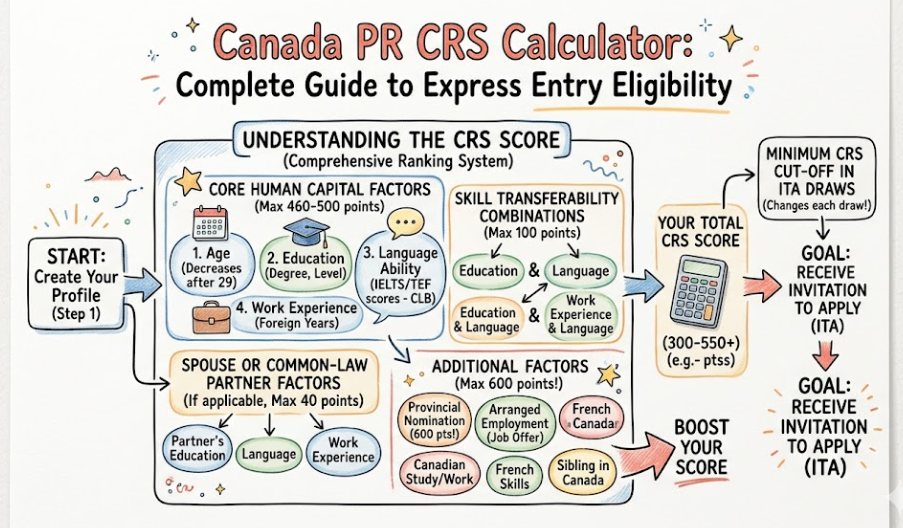
How the CRS Points System Works
The CRS assesses your background based on “human capital.” It evaluates your potential to contribute to the Canadian economy.
Core Factors
- Age: Generally, younger candidates receive higher points, as they have a longer potential career span in the country.
- Education: Higher levels of schooling (Master’s, PhD) yield more points.
- Language Skills: Proficiency in English or French (verified by tests like IELTS or CELPIP) is non-negotiable.
- Work Experience: You earn points for both Canadian and international work history in skilled occupations.
Table: Core CRS Scoring Overview
| Factor | Description | Potential Impact |
| Age | Points decrease slightly as you get older. | High |
| Education | Bachelor’s, Master’s, or PhD credentials. | Very High |
| Language | Proficiency in English or French. | Critical |
| Work Exp. | Skilled experience (TEER 0, 1, 2, 3). | High |
| Adaptability | Family in Canada, study, or job offers. | Bonus Points |
Canada Express Entry Pathways Explained
It is important to understand that the Canada Express Entry points system manages three distinct programs:
Federal Skilled Worker Program (FSWP)
Designed for people with foreign work experience. You need to meet minimum language requirements and demonstrate that your work experience is in a skilled category.
Canadian Experience Class (CEC)
Tailored for those who have already worked in Canada. If you have spent time in Canada as a temporary worker, this is often the fastest route.
Federal Skilled Trades Program (FSTP)
This is for qualified tradespeople (electricians, welders, etc.) who have a valid job offer or certificate of qualification.
Step-by-Step Example of Canada CRS Score Calculation
To make this practical, let’s look at three hypothetical profiles.
Example 1: The IT Professional
- Profile: 29 years old, holds a Master’s degree, 4 years of work experience, high IELTS scores.
- Calculation: They benefit from peak “Age” points and strong “Education” points. Their high language score pushes them into the top tier of candidates.
Example 2: The Healthcare Worker
- Profile: 34 years old, Bachelor’s degree, 6 years of experience, moderate IELTS scores.
- Calculation: They have solid work experience points but lose a few points due to age. By focusing on increasing their language score, they can bridge the gap.
Example 3: The International Graduate
- Profile: 24 years old, Canadian post-secondary degree, 1 year of work experience.
- Calculation: Their Canadian education provides a massive “Adaptability” bonus. They are highly competitive for the CEC stream.
How to Increase Your Canada CRS Score
If your score is currently below the average cut-off, don’t worry. Many applicants start lower and boost their score over time.
- Retake Language Tests: Improving your CLB (Canadian Language Benchmark) level by even one band can add significant points.
- Education Upgrades: If you have a Bachelor’s, earning a professional certificate or a Master’s degree can change your point bracket.
- Gain Experience: Completing another year of skilled work adds up quickly.
- Provincial Nomination: This is the “gold standard.” If a province nominates you, you gain 600 points, which almost guarantees an invitation.
- Spouse Profile: If your spouse has strong education or language skills, adding them to your application can increase your total score.
Common Mistakes to Avoid
- Wrong Calculation: Misidentifying your NOC (National Occupational Classification) code. Always verify your job duties against the official list.
- Ignoring Language Requirements: Many applicants assume their English is “good enough” without taking a formal test.
- Outdated Criteria: Immigration rules change. Always use the most current Canada PR CRS Calculator and verify requirements on official government portals.
- Missing Documents: Incomplete records for your work history or education can lead to rejection.
Frequently Asked Questions (FAQs)
1. What is the Canada PR CRS Calculator?
It is a tool that estimates your Comprehensive Ranking System score based on your personal profile.
2. What is a good CRS score?
“Good” changes with every draw. Check the latest IRCC draw results to see the current cut-off scores.
3. Is IELTS mandatory?
Yes, you need valid language test results to prove your proficiency in English or French.
4. Can I move to Canada without a job offer?
Yes, the FSWP does not strictly require a job offer, though it helps with points.
5. Does age affect my score?
Yes, points for age start to decline after age 29.
6. How accurate are online calculators?
They are estimates. Your official score is calculated when you submit your profile to the government.
7. Is Canada PR easy to get?
It is a competitive process that requires preparation, documentation, and patience.
8. What jobs are in demand?
Healthcare, STEM, and trades are consistently in high demand.
9. Can family members join me?
Yes, your spouse and dependent children can be included in your PR application.
10. How long does the process take?
Processing times vary, but Express Entry is generally one of the faster pathways.
11. What is the difference between FSWP and CEC?
FSWP is for foreign experience; CEC is for Canadian experience.
12. Can I use the calculator if I am a student?
Yes, but you will need to meet the work experience criteria for a specific program to be eligible.
Conclusion
The Canada PR CRS Calculator is your first step toward a new life. It provides clarity in a process that can feel overwhelming. By focusing on the factors you can control—language, education, and skill development—you position yourself as a strong candidate.
Canada is looking for talent. If you are prepared, organized, and dedicated, your dream of living and working in Canada is well within reach. Start by gathering your documents, check your eligibility today, and take the first step toward your future.

Find Trusted Cardiac Hospitals
Compare heart hospitals by city and services — all in one place.
Explore Hospitals
PakarPBN
A Private Blog Network (PBN) is a collection of websites that are controlled by a single individual or organization and used primarily to build backlinks to a “money site” in order to influence its ranking in search engines such as Google. The core idea behind a PBN is based on the importance of backlinks in Google’s ranking algorithm. Since Google views backlinks as signals of authority and trust, some website owners attempt to artificially create these signals through a controlled network of sites.
In a typical PBN setup, the owner acquires expired or aged domains that already have existing authority, backlinks, and history. These domains are rebuilt with new content and hosted separately, often using different IP addresses, hosting providers, themes, and ownership details to make them appear unrelated. Within the content published on these sites, links are strategically placed that point to the main website the owner wants to rank higher. By doing this, the owner attempts to pass link equity (also known as “link juice”) from the PBN sites to the target website.
The purpose of a PBN is to give the impression that the target website is naturally earning links from multiple independent sources. If done effectively, this can temporarily improve keyword rankings, increase organic visibility, and drive more traffic from search results.