


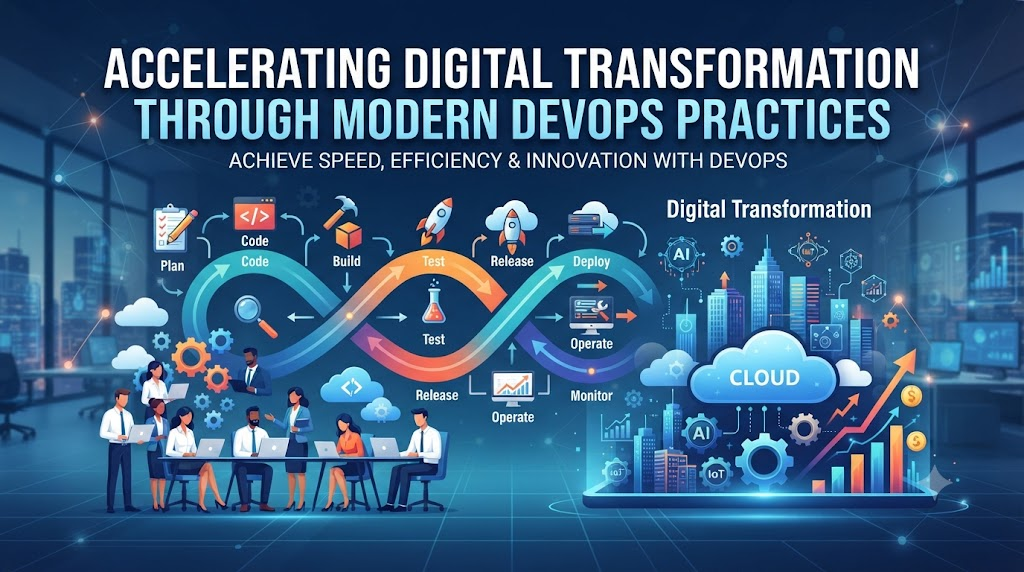
Organizations today face constant pressure to modernize their operations, scale rapidly, and deliver software that meets the evolving expectations of users. Traditional software development and operations approaches often fall short in this environment, creating rigid silos, slow release cycles, and high vulnerability to change.
Digital transformation is not merely about adopting new technologies; it is a fundamental shift in how an organization operates, builds products, and delivers value. At the core of this evolution lies DevOps—a methodology, culture, and engineering practice that bridges the gap between software development and IT operations. This article explores how DevOps practices enable and accelerate digital transformation, detailing the technical and business impacts, key implementation steps, and future industry trends.
Understanding Digital Transformation
Digital transformation represents a holistic integration of digital technology into all areas of a business, fundamentally changing how organizations operate and deliver value to customers. It goes beyond migrating legacy systems to the cloud or digitizing paper processes; it requires a cultural and structural shift toward agility, experimentation, and continuous optimization.
Why Software Delivery Speed Matters
In a competitive market, the ability to release software quickly and safely determines an organization’s responsiveness. When a business can push updates, patches, and new features rapidly, it can capture market opportunities faster, respond to customer feedback immediately, and outpace competitors.
The Role of Modern Engineering Practices
Modern digital transformation relies heavily on cloud computing, infrastructure automation, data-driven decision-making, and robust engineering pipelines. However, without the right operational framework, these technologies can create complexity rather than efficiency. Traditional development and operations approaches—where developers write code and toss it over a wall to operations teams—create critical bottlenecks, finger-pointing during outages, and protracted release cycles that stall business growth.
What Is DevOps?
DevOps is a comprehensive cultural, methodological, and engineering practice designed to unify software development (Dev) and IT operations (Ops). Rather than being just a collection of tools, DevOps is built on several foundational pillars:
- Shared Responsibility: Eradicating organizational silos so that development, testing, security, and operations teams share accountability for the entire software lifecycle.
- Automation: Eliminating repetitive manual processes across building, testing, and deployment to ensure consistency and speed.
- Continuous Integration and Continuous Delivery (CI/CD): Frequently merging code changes, running automated tests, and streamlining deployment pipelines.
- Infrastructure Automation: Managing and provisioning computing environments programmatically.
- Monitoring and Feedback Loops: Tracking system performance and user experience continuously to drive iterative improvements.
How DevOps Supports Digital Transformation
DevOps acts as the engine of digital transformation by addressing the core inefficiencies of traditional IT delivery.
Faster Software Delivery and Automation
By implementing CI/CD pipelines, teams can automate the build, test, and release phases. This reduces manual intervention, cuts down deployment times from months to minutes, and minimizes human error.
Cloud Adoption and Infrastructure as Code (IaC)
Cloud computing provides the elasticity required for digital transformation, while Infrastructure as Code ensures that cloud environments can be provisioned, replicated, and scaled reliably using code configurations rather than manual setups.
Containers, GitOps, and Security Integration
Containerization ensures applications run seamlessly across different environments, from developer laptops to production servers. GitOps leverages Git repositories as the single source of truth for declarative infrastructure and application deployments, enhancing consistency. Meanwhile, DevSecOps embeds security checks early into the software delivery pipeline rather than treating security as an afterthought.
Key DevOps Practices for Digital Transformation
To achieve sustainable transformation, organizations rely on a specific set of interoperable engineering practices.
1. Continuous Integration and Continuous Delivery (CI/CD)
- What it is: A practice where code changes are automatically built, tested, and prepared for release.
- Why it matters: It breaks down massive, high-risk release events into small, frequent, and manageable updates, drastically reducing failure rates.
2. Infrastructure as Code (IaC)
- What it is: Managing and provisioning computing infrastructure through machine-readable definition files.
- Why it matters: It eliminates configuration drift, allowing teams to spin up identical staging and production environments within minutes.
3. Containerization and Orchestration
- What it is: Packaging applications and their dependencies together into lightweight containers (e.g., Docker) managed by orchestration tools.
- Why it matters: It guarantees environment consistency and portability across hybrid and multi-cloud architectures.
4. DevSecOps
- What it is: Integrating security practices (such as static and dynamic code analysis) into every phase of the CI/CD pipeline.
- Why it matters: It shifts security left, identifying vulnerabilities early when they are inexpensive and easy to fix.
5. Observability and Site Reliability Engineering (SRE)
- What it is: Utilizing logs, metrics, and traces alongside reliability principles (like SLOs and error budgets) to understand system health.
- Why it matters: It transforms reactive troubleshooting into proactive performance management, ensuring high availability for digital services.
Business Benefits
The integration of DevOps and digital transformation delivers measurable advantages across business units:
- Faster Time to Market: Features and products reach customers quicker, enabling organizations to capitalize on emerging market trends.
- Improved Operational Efficiency: Automation reduces manual toil, allowing engineering teams to focus on innovation rather than maintenance.
- Greater Reliability and Customer Experience: Frequent, smaller releases combined with robust observability lead to fewer outages and higher customer satisfaction.
- Enhanced Adaptability: Organizations can pivot strategies and update software rapidly in response to shifting business requirements.
Technical Benefits
From an engineering standpoint, DevOps practices resolve chronic infrastructure and deployment friction:
- Deployment Consistency: Eliminates the classic “it works on my machine” problem through standardized containers and automated environments.
- Faster Recovery and Incident Response: Automated rollbacks, centralized logging, and clear observability shorten Mean Time to Resolution (MTTR).
- Reduced Configuration Drift: IaC ensures that production environments remain identical to development and staging setups over time.
- Scalability: Cloud-native automation allows systems to scale up or down dynamically based on user demand.
Real-World Implementation
Adopting DevOps is a journey that requires careful planning rather than a sudden overhaul. A practical, phased approach helps organizations transition smoothly:
- Assess the Environment: Evaluate current development workflows, deployment bottlenecks, and team structures.
- Identify Bottlenecks: Pinpoint where code gets stuck—whether in manual QA, lengthy approval chains, or release management.
- Establish Version Control: Ensure all application source code and infrastructure configurations live in centralized version control systems.
- Introduce Automated Testing: Build a reliable suite of unit, integration, and regression tests.
- Build CI/CD Pipelines: Automate the compilation, testing, and staging of code changes.
- Automate Infrastructure: Implement IaC to manage cloud resources programmatically.
- Adopt Containers and Cloud: Standardize application packaging and leverage cloud-native services.
- Integrate Security: Embed automated security scans into the deployment pipeline.
- Implement Observability: Deploy centralized monitoring, logging, and tracing tools.
- Measure and Improve: Track key metrics (such as deployment frequency and lead time) and continuously refine processes.
Common Challenges and Solutions
Organizations often encounter hurdles during their DevOps journey. Recognizing these challenges helps leadership prepare effective countermeasures.
- Resistance to Cultural Change: Overcome cultural inertia by emphasizing collaboration, celebrating small wins, and fostering psychological safety.
- Skills Gaps: Address technical deficits by investing in structured training programs and continuous professional development. Organizations looking to upskill their teams in modern workflows can explore specialized technical education platforms like DevOpsSchool to build core competencies in automation, cloud engineering, and CI/CD.
- Legacy Infrastructure: Modernize legacy systems incrementally by wrapping them in APIs or migrating workloads to containers step-by-step.
- Tool Sprawl: Avoid adopting too many disconnected tools by establishing a cohesive, standardized toolchain that fits team workflows.
Best Practices for Success
- Align with Business Goals: Tie technical metrics directly to business objectives to secure leadership buy-in.
- Automate Incrementally: Focus on automating high-friction, repetitive tasks first before attempting end-to-end pipeline automation.
- Break Down Silos: Encourage cross-functional collaboration by embedding operations, security, and quality assurance engineers directly into product teams.
- Measure What Matters: Track core engineering metrics (such as lead time, deployment frequency, change failure rate, and time to restore) to evaluate progress objectively.
Role of DevOps Training and Skill Development
Successful digital transformation relies heavily on human capital. Tools and cloud platforms are only as effective as the engineers operating them. Cultivating deep expertise in automation, containerization, Infrastructure as Code, and observability is essential for modern IT teams. Upskilling internal staff ensures that organizations can maintain momentum, innovate securely, and adapt to emerging technological landscapes without depending entirely on external consultants.
Future of DevOps and Digital Transformation
The landscape of software delivery continues to evolve rapidly. Key future trends include:
- AI-Assisted DevOps (AIOps): Utilizing machine learning to predict system anomalies, automate incident triage, and optimize pipeline performance.
- Platform Engineering: Building internal developer platforms (IDPs) that provide self-service capabilities, reducing cognitive load for software engineers.
- Advanced DevSecOps: Moving toward proactive security postures with real-time threat intelligence integrated directly into automated build chains.
- Cloud-Native Evolution: Deeper adoption of serverless architectures, service meshes, and edge computing.
Frequently Asked Questions
What is the role of DevOps in digital transformation?
DevOps provides the cultural and technical framework required to break down organizational silos, automate workflows, and accelerate software delivery, enabling businesses to adapt quickly to digital demands.
How does DevOps accelerate digital transformation?
By replacing manual, error-prone processes with automated CI/CD pipelines, infrastructure as code, and continuous monitoring, DevOps drastically reduces the time it takes to turn an idea into a production-ready feature.
Why is automation crucial in DevOps?
Automation eliminates repetitive manual toil, ensures absolute repeatability across environments, reduces human error, and allows engineers to focus on high-value product innovation.
What challenges do organizations face when adopting DevOps?
Common hurdles include cultural resistance, legacy infrastructure constraints, tool complexity, and a lack of internal technical skills. These are best addressed through incremental change and targeted training.
Is DevOps necessary for digital transformation?
While an organization can adopt new technologies without DevOps, sustainable digital transformation—characterized by speed, agility, resilience, and scale—requires the cultural and operational shifts that DevOps provides.
Final Thoughts
Digital transformation is a continuous journey rather than a one-time project. Organizations that succeed are those that view technology, processes, and people as an integrated ecosystem. By embracing DevOps practices—such as automation, continuous integration, robust observability, and cross-functional collaboration—businesses can overcome legacy bottlenecks, enhance operational resilience, and deliver exceptional value to their customers. Committing to a culture of continuous learning and iterative improvement ensures long-term adaptability in a rapidly changing digital world.

Find Trusted Cardiac Hospitals
Compare heart hospitals by city and services — all in one place.
Explore Hospitals
PakarPBN
A Private Blog Network (PBN) is a collection of websites that are controlled by a single individual or organization and used primarily to build backlinks to a “money site” in order to influence its ranking in search engines such as Google. The core idea behind a PBN is based on the importance of backlinks in Google’s ranking algorithm. Since Google views backlinks as signals of authority and trust, some website owners attempt to artificially create these signals through a controlled network of sites.
In a typical PBN setup, the owner acquires expired or aged domains that already have existing authority, backlinks, and history. These domains are rebuilt with new content and hosted separately, often using different IP addresses, hosting providers, themes, and ownership details to make them appear unrelated. Within the content published on these sites, links are strategically placed that point to the main website the owner wants to rank higher. By doing this, the owner attempts to pass link equity (also known as “link juice”) from the PBN sites to the target website.
The purpose of a PBN is to give the impression that the target website is naturally earning links from multiple independent sources. If done effectively, this can temporarily improve keyword rankings, increase organic visibility, and drive more traffic from search results.